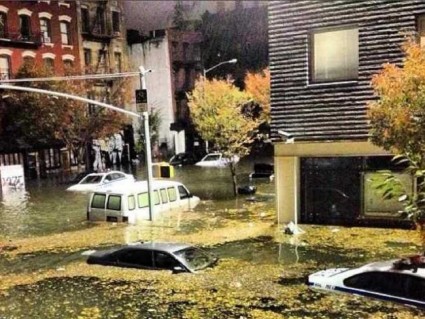
Wednesday, October 31, 2012

In Consideration of the Unanticipated Varieties of Disaster

People who lived in this neighborhood likely could just not imagined something which has simply never happened there before, otherwise, they would have filled their cars Friday and driven as far from here as they could.


     I spend a fair amount of my time describing and passing along specific actions families can take in order to prepare for, and cope with natural and man-made disasters.  There is certainly a lot that families and individuals can do in order to plan for such events.  We can have emergency kits assembled and ready. We can have Evacuation Notebooks structured and assembled so that when we are overwhelmed, we have quick access to a plan we custom made for ourselves when we had a calmer, cooler head and carefully considered our strategy.  We can prepare our children for possibilities, and tell them the truth, which is that whatever happens, you have a plan, and you will move Heaven and Earth to keep them safe.  I will even go as far to say that we can make MOST disasters safer for us, and we can go a long way through advance planning to keep those with medical issues alive through a true disaster.
              However, I feel the need here to address the "No Win Situation" or the "Worst Case Scenario".   Most of the time when disasters occur, there is some warning.  There often IS time to grab your Evacuation Notebook, skim your personalized plan, make a decision as to whether you should shelter-in-place or evacuate your home. Then, grab your Evacuation Medical Kit adding any prescription meds, nebulizers or any other equipment your family uses medically, grab your pets and their bag, and then flee.  Your document bag should also be ready to go.  Many people find locking all of these things in one closet is helpful and allows them to be updated quickly periodically.
              Sometimes though, there is not time for adequate preparation.  Sometimes an aspect of a certain disaster occurs in a manner that we did not anticipate.  Sometimes, something we never dreamed would happen, actually does.  Sometimes, there is the true, "Worst Case Scenario" where we are lucky to escape with our lives.   Last week, I was visiting an area in which a large reservoir sat above a region of homes below.  I was not pleased with the engineering of such a thing.  It seemed unwise to me to build homes below such a vast water reserve.  If this reservoir ever ruptures as a result of unprecedented rains, a direct tornado hit, or even seismic activity, the people below will die, as there will likely be insufficient time to evacuate, at least close to the reservoir itself.    There are predictable potential no win situations.   Living below the reservoir is one of those.  There are others which could not easily be anticipated.  The death of my twelve year old son when I could do CPR, but had no AED was one of those.  We had no reason to know we needed to have an AED in our home.  His first spontaneous heart rhythm disturbance, was simply his last. He had no prior medical history of any kind which suggested such a problem.
              So, the take away from this post should be, a commitment to do whatever we can to anticipate reasonable natural and man-made disasters which could befall us in whatever location we choose to live. There is much we can do in terms of risk management, and meeting those risks head on.   However, when we do reach the event for which we could not fully plan, or when we meet someone who has, lets provide to them understanding and assistance when we can, rather than judgement for a failure to anticipate such a thing.  Even bright people can linger in normalcy bias long enough to waste critical moments in advance of an evacuation. Lets keep calm heads, and provide understanding to those survivors who for whatever reason were caught in a cosmic surprise.


Tuesday, October 30, 2012

Reflections on Sandy

Note nurse in gurney. She is holding a sick neonate.
   

Lets pray that all the sick newborns, newborn babies, children, and sick adults who must be relocated during their illnesses fare safely and well.


     Here in my own rural area of Virginia, despite heavy rains, winds, and some snow from this peculiar storm, we are fine, and so are our animals.   Thank you to people from Russia, Belgium, the UAE, and Nova Scotia who have inquired as to how we are faring.
           This morning I have been watching television and noticing so many things with regard to evacuation and disaster preparedness.   New York and New Jersey have been badly hit, and the infrastructure there is likely not to recovery for weeks.  I saw something this morning which interested me there.  New York University Medical Center had a situation where the level of the hospital which housed their back up generators during the outage had flooded.  This necessitated an evacuation of the hospital including the Neonatal Intensive Care Unit.  In my youth, when I rotated through the NICU, if we evacuated, we did so with all babies in incubators.  The news program I saw yesterday showed NICU nurses in scrubs being removed from the hospital in a gurney, clutching tightly a small baby with nasogastric tubes and oxygen masks intact.  This was interesting to me because this is not how we would have performed an evacuation.  The more I thought about this, the better idea this sounded.  Holding an infant tightly will decrease stress, stabilize blood pressure and pulse and contribute to security. Holding the infant will also help to naturally absorb bumps which could occur as an incubator or gurney navigated streets or curbs during the evacuation. I have been thinking and breathing disaster preparedness and evacuation for twenty-five years, and still each day, I learn or are exposed to something else.
           The second thing I heard annoyed me.  Good Morning America had a child psychiatrist on to help urban parents deal with "unstructured time" due to mass cancellations in the storm.Have we, as a culture, fallen so far that we need a professional to tell us how to deal with our own children when school is cancelled?   It's one thing to deal with a child's feelings of anxiety when a disaster occurs.  It's quite another to be at one's wits end because you have no idea how to redirect the attention of the child you brought into the world.  Perhaps the answer is not to overbook your child every spare minute, and learn to talk to him about his hopes, his fears, and his wishes for the future.  Not everything about a disaster is entirely bad.

         Lastly,  I never tell anyone what they should believe or to whom they should pray. However, I would be less than honest and less than who I am if I were not honest about the fact that I pray unceasingly to Jesus Christ, and that the honor and glory for everything that I do that's any good in the world, goes to Him. Therefore, I am sending this prayer out for everyone, Christian, Muslim, Jew, or Agnostic who is adversely impacted by this rare and complex storm.


   Heavenly Father,

             Please help those displaced and effected by Hurricane Sandy to find support, encouragement and safety in this confusing and frightening time.   May they feel supernatural caring and support from you and from those on Earth who are entrusted with Earthly help here.  May they have their medical problems addressed, and find their fears addressed as they realize that they have been granted a continued opportunity to learn and laugh and play in this schoolyard of a world you created for us.  Please address the practical, as well as the loss, and the bewilderment and sorrow.   For those who have lost a loved one, please be with them, and provide to them the love and solace you so graciously provided to me, following the loss of my young son and of my father.     Thank you for the blessings that we know to thank you for, and for those of which we are so blissfully unaware.   In Jesus name I pray.
           Amen.

Monday, October 29, 2012

Hurricane Sandy: An Impressive Storm

This is rainfall probability from NOAA for Hurricane Sandy on DAY ONE alone.


This is Wind Speed Probabilities of Hurricane Sandy from NOAA.  Note the widespread nature of this storm. This does not include the Noreaster which will join it from the West.


             By now you likely know that Hurricane Sandy is a rare hybrid storm. A number of conditions have converged which make this an interesting and challenging storm.   It is estimated that more than fifty thousand Americans who reside in the Eastern US will be impacted by this storm.  Eight states have declared a State of Emergency.

            It certainly is unusual to have one storm engulf both our farm and also our "Bug Out Location" and our "Tertiary Bug Out Location" as well.

           Rather than focusing on how things are going here, I would like everyone to look at their own situations and do whatever you can to remain safe, whether it is sheltering-in-place in your homes, or whether it is rapid Evacuation with your pets, which has been ordered in some locations.

This is the Hurricane Sandy Situation Page:


http://www.vuetoo.com/sandy/Situationpagenews.asp?sit=6512

  Stay safe !


Sunday, October 28, 2012

Hurricane Sandy: The Long List of Things Done and Yet to Do

Virginia in Autumn


 In the interest of jogging your own memories as to what you might need to do before a hurricane or major storm, I am going to share what we did yesterday, here on the farm.


1.  The dogs who reside primarily in the main kennel have been upset as they sense barometric pressure changes and wind.  I visited each of them, checked them and made sure everyone was ok. I tried to be reassuring.
2. Then, I visited the two dogs which will be on patrol through the farm throughout the storm itself. (They have safe houses and a way to get into a secure building if they choose.)  Ben, a large golden retriever, and Skye, a Collie, are on duty in the early part of this week, before they rotate back to the kennel for two others to patrol and "go out to work."
3. All the alpacas have been visited and assessed.  We keep a large separate water tank for them which is pumped using a marine battery with a tiny pump house. This was filled to the brim should there be any interruptions in electricity which could complicate water for animals.
4. Duck homes were rebuilt about eight weeks ago.  They should weather this storm well, and they tend to love storms anyway.
5. Yesterday, my husband removed the camouflage tops to each of the five chicken enclosures.  Our thinking is that the tops tend to catch the wind and topple even the heavier chicken structures during severe storms.
6. All tractors, riding lawn mowers, ladders, and other structures have been placed in the equipment barn.
7. The windows on the second story of the alpaca barn which are normally kept open because they have screens were closed to prevent water from entering.
8.  Adequate feed for nine dogs, 100 chickens, 10 ducks, 8 alpacas, 2 cats, and 7 people was obtained and put away here yesterday. We also have fresh hay for the animals who use it.
9. We spent some time with and spoiled our pretty barn cat. She does not like storms.  Our indoor cat is semi-consciously sleeping.
10. Secured outdoor white iron furniture on back deck, along with gas grill. (These were already covered for winter)   Secured all outdoor iron furniture on front porch.  Removed house flag from front.  Removed light furniture from porch including outdoor cushions.
11. Removed large number of porch hanging plants. Will relocate them to garden shed with big windows. (Like a greenhouse with fewer windows.)  We watered them before putting them away because I may not get down there all that quickly if the storm is large and the power is out for awhile.
12. Husband completed survey of alpaca outpost roof,  Reinforced a couple of areas.
13. Filled all cars with diesel or gasoline as appropriate.  Collected diesel fuel in containers for generator. Collected gasoline for reserve generator and lawnmowers.
14. Husband started  all generators, just to make sure all is well.  He also located oil for their oil changes, and new oil filters for maintenance which must be done after use.  I put out another piece of older wood to go on top of the canopy over the generator.
15. Newest car will be garaged through worst part of the storm.
16. Bought extra bottled water in the event that the power goes out and the weather is so bad we don't feel like going outside to pump any.  This will be the first major outage where we can actually pump our well water and pressurize our houses water system using the Simple Pump.   (www,simplepump.com)
17. This week I ran a quick check on prescription medications making sure there is enough for at least the next two weeks. There is enough of all items for at least a month.
18. I went to Lowes this morning to get extra buckets.  Not sure why, but I can't find mine.
19. Our daughter pulled everything out of her refrigerator and freezer and placed it in ours. We have a generator and will continue to keep food cold or frozen.  She could be without power for 7-10 days.

 This is all I believe I have done and recall.  I hope something here reminds you of something you could do.

This is the Hurricane Sandy Situation Page:

  http://www.vuetoo.com/vue1/SituationPageNews.asp?sit=8118&ref=anm


Stay safe !


Saturday, October 27, 2012

Sandy, a Dangerous Hybrid Storm

No one can tell you whether this storm will bring flooding, protracted power outages, mandatory evacuation,  heavy snow, blizzards, tree damage, or other heavy wind damage.  Different locations will certainly have varying experiences with this storm.All that we can do is plan, anticipate, and hope for the best.
       

    In the next few days, the East Coast of the United States is about to have an encounter with Hurricane Sandy.  Sandy is virtually a unique storm in that it is a hurricane which will be combined with a Noreaster, a significant snowstorm, with an additional weather front. This storm is going to leave the East quite cold afterward.  Incidentally, this is also occurring over a full moon, which may contribute to a higher storm swell.   Tens of millions of Americans off the East Coast are likely to be impacted by this storm.   Many locations along the East Coast are under mandatory evacuations.  This storm will then move on to Canada.
          I know that if you are a follower of this blog then I am preaching to the choir, however, it is important to prepare.


1. Make sure you have bottled water.   Even if you are like me, and have a hand pump feature on your well, severe flooding could adversely impact your well in some places.

2. Obtain bread, peanut butter and non-perishable foods for perhaps a week.  Power outage estimates in some places could be one or two weeks depending upon your location.

3. Fill up your car and get some cash from the ATM. Grab whatever you need for the next week from the pharmacy.  If there is a protracted outage, then none of these things will be possible soon.   Get cyalume lightsticks, or flashlights, batteries, etc.  Get diapers if you use them.  Charge ALL of your phone and chargeable devices right now.

4. Secure or being in your lawn furniture.  This storm is also unusual in that you should also keep shovels near your doors because at the end of this peculiar hurricane, you may be shovelling snow.

5. Make whatever arrangements you can to cancel your activities in the early part of next week.  Very little that we do is worth risking our lives over.

6. If you are ordered to evacuate, then please do so, and take your animals.

   This is a Sandy google map which is updated regularly:

     http://google.org/crisismap/sandy-2012


     This is one of the things we prepare for.  I am praying for each of you.  Stay safe, stay home if you can, and help whomever you can.


Friday, October 26, 2012

Avoiding Buying a Home Which Was Used in the Drug Trade

ANY home may have been used in the drug trade, and it may not be immediately obvious.
          
     Even the title is amusing. Who would buy a house that was involved in any way, in the illicit drug trade ?  The fact is that many people do, and they have absolutely no idea until something disastrous happens there.  It used to be that it was easy to avoid buying a "drug den".  Such places were always in bad neighborhoods and were dirty or obvious.  In fact, a realtor might not even accompany you to a dangerous location.  This is no longer true.  Some very lovely and gracious homes have been part and parcel of the drug trade.  In addition, some very nice rural homes in serene areas have also been involved in the illicit drug trade.  It's also true that there are many different ways in which the drug trade might use a home.  Some homes might be used to grow tree sized marijuana, or to start plants indoors or in windowed outbuildings. Other homes might be used as a place to stock drugs as the owner may be involved in illicit drug distribution. Some people stock the drugs and allow another dealer to pick it up at his location.  Others actually sell drugs from their home.  In some of these locations marijuana is the only drug involved.   In others, methamphetamines are being cooked on stove tops. This is a particularly dangerous practice and has damaged the people who move into such homes afterward, as these noxious chemicals are in carpets, walls, and everywhere else.  Young children are particularly sensitive to these remaining chemicals and at least one recent death has been attributed to moving in to an unknown former meth lab, and breathing in the environment.  Of course crack cocaine, and cocaine and even heroin dealers also have homes and may distribute from them.
              According to law enforcement, as the economy has worsened, both inner city and rural clandestine drug labs and distributors have appeared.  Police call these "clan labs".   Some of the people who run such operations from their homes don't pay their mortgages, and a number of these clan labs become homes in foreclosure.  Pay close attention to this article before you buy a US foreclosure.  It may well be anything from a low level "pot farm" to a "meth lab" to a source for multiple types of drugs.  You may not simply be endangered by the fumes of such a place, but by those who may return to look for drugs, cash, or to eliminate their own competition whom they assume may still live there.
             These are some things which may indicate that your "dream home" has a checkered past in this regard:

  1.  Use caution any time you are considering buying a repossession where you are told "the owners defaulted because they are in jail for drug abuse/sales."
  2.  Pay attention when the neighbors of the repossessed home you are considering says that they thought there was drug activity there.
  3. Be alert to soil in peculiar places like kitchen cabinets. Marijuana grow houses often spill soils and vermiculite and this can cause unseen mold in a house, so this can be a telltale sign. Some references say that marijuana grow houses may have bad wiring as a result of frequent irrigation.
 4.  When purchasing, write a Contract contingent upon a whole house inspection. Then, have a good inspection done and ASK them to look for signs of drug activity.
 5. In the US, Call the DEA.  Ask them  Most of their offices will send a couple of agents to sweep and test your home.
 6.  Consider the possibility of the prior owners or tenants "meth cooking" when the house is being sold with the stove gone.
7.  Do not move infants or children especially into a former meth. house.  Although the residual contaminants are dangerous to everyone, they are especially dangerous to young children.
8. When you do buy a home, change the locks and pay a reputable handyman or builder to reinforce your exterior door frames.   This would make it much harder to kick the door in, particularly at night.  If this is done correctly, the door won't be kicked in very easily and a metal door would be destroyed but would not allow entry. Attempted entry would not only be very time consuming for someone, but would be very noisy, as well.

       In addition to the potential environmental hazards of former drug selling or manufacturing homes, there is another hazard of which you should be aware.  One of my firearms trainers told me of a man who bought a new house and then have several people attempting to enter it through the master bedroom window in the middle of the night.  The new owner shot one of them.  It seems that sometimes former drug partners, original owners or buyers will try to enter to either look for residual hidden cash or perhaps even hidden drugs.   Many people have bought lovely repossessions and have had a version of this scenario occur.  Make sure you do your best to anticipate such a possibility.
         

         Keep in mind that the very same things which make a home attractive to someone interested in preparedness or survival, are things a drug dealer might seek also.  Both may be drawn to a solid home, with privacy, without neighbors too close,  with plenty of storage, particularly  hidden storage. Notice rooms with hidden closets or where there is a dropped ceiling, or hidden attic storage. Note hidden storage below wood floors. Both groups might like some acreage and lots of parking. Both may seek a place a distance from town, but of course, for very different reasons.    So when a person who is interested in preparedness finally finds the perfect home, and it is a foreclosure, for example, they may well have selected a former drug haven of some kind..
        Remember that when a bank or governmental agency sells a house they provide lots of documents which hold them blameless from the activities of the prior owners.  If they have sold you a home which is eventually found to need fifty thousand dollars worth of remediation, then this is your problem.  Some families have had to bulldoze such a home and start again, with no accountability whatsoever from the bank or government agency who sold them the home.


More information on this topic:

 http://methlabhomes.com/about-us/my-meth-lab-home-story/

http://realestate.msn.com/article.aspx?cp-documentid=26924092

http://realestate.aol.com/blog/2012/06/28/family-forced-to-tear-down-home-because-it-was-meth-lab/


Sunday, October 21, 2012

Regarding Pain Management Departments

spinedockc.com
      

      There have always been physicians or medical professionals of one type or another who devote a portion of their practice to managing pain.  Some chiropractors focus on pain abatement, and some of them have received training and certifications in order to become physician acupuncturists. Physical Therapists and Massage Therapists also do a great deal in order to manage chronic pain of many causes also.  There are also acupuncturists who are non physicians but who also have loyal followings of patients who have been at least somewhat delivered from chronic pain.
              I was aware that some hospital systems and medical centers have a Pain Management Department. I imagined this to be designed for the terminally ill, or those with multiple spinal fractures or trauima. I have never sent a family member, or accompanied one to a Pain Management Center at a major medical center which has a medical school.
              My eldest son, who is in his twenties has been experiencing some pretty severe symptoms following a lightning strike for a bit more than a year.  His primary physician is a highly regarded and well educated physician who has completed a couple of different residencies, including a fellowship in sports medicine. He has been unable however to do much about our son's continued leg pain which began to occur within a week or two of being struck by lightning while in a steel roofed building here on the farm.  Eventually, our son was sent for an EMG which seemed normal. However, our son was still bothered by significant leg pain and something called fasiculations, which are intermittent episodes of twitching in skin and muscles of both legs.  He had tried a TENS unit, and even narcotic medication, neither of which were terribly effective.  Eventually, he was referred to the "Pain Management Department".
                This department was not at all what I expected.  It is a multi-disciplinary team which meets with each patient, pulls their medical records and formulates a plan for management.  The director of the program is a board certified physician who is an anesthesiologist who has furthur specialized in the management of pain. She is also responsible for physicians who are also board certified physician anesthesiologists who are doing a fellowship in pain management.  Their patients include those who have had terrible accidents, workmen's comp injuries, burns, and those who have been left with phantom pain in a limb which has been long since amputated. They do see cancer patients, and on occasion, they also see those who have sustained injury and who have protracted pain which is the result of lightning strikes.   They are not restricted to the practice of handing out medications for pain willy nilly.   They focus on ascertaining the cause for pain and formulating a team approach to managing pain. They were very clear that narcotic pain management only ever works in the short term and that other strategies for pain must be planned for patients. Such plans must allow the patient to reach his maximum level of function.
                In my son's case, they were quite clear that the twitching in his legs constituted mild myoclonic seizures which could easily be attributed to lightning strike. They also did a neurological exam.  They prescribed a drug which would stop the switching in his legs, which is normally used for seizures.  They also prescribed a skeletal muscle relaxant that he could take if the pain became more severe.  With these issues managed, they wish him to begin to wean the narcotic tablets he had been taking.  They also obtained lab work in order to make sure that his calcium, magnesium and other levels obtained in a blood chemistry level are at levels which are optimal for his recovery. They believe that his supplemental magnesium given by prescription will need to be increased.  They also have referred him to another physician member of their team who teaches both pain management meditation and self hypnosis which he can use as his recovery takes place.They did not do this in my son's case, but they frequently refer patients to physical therapy as well.  They were careful to tell him that his nerves in his legs will likely never be as they were prior to being struck.  They also said that if the twitching of his legs could be made to stop for a period of time, and that if he could finally sleep a full eight hours a night, (which is not happening now), that he could begin to repair even the nerve damage he had sustained, and had potential to recover from this particular issue.
                So far, a fairly low level of the drug being taken to diminish the leg twitching is being taken, yet he is  better. They have left directions for it to be gradually and carefully increased, and we will remain in touch via e-mail. In just a few days he has markedly decreased the amount and frequency of narcotic he had been using for leg pain.  He has not yet used the skeletal muscle relaxant which was prescribed as needed, because he feels that he is doing well and doesn't need it presently.   He has not yet seen the physician who will use biofeedback, hypnosis and meditation.
               I must say, that a challenge which has kept other physicians thinking and reading was short work for a multi-disciplinary pain management team.  A neurologist will see him tomorrow to see that we are covering all the bases.    I am incredibly impressed and grateful for the expertise of this team of physicians. This is the way the team approach is supposed to work !

Artists conception of pain :  nuhopecare.com
               From a preparedness and survival standpoint, addressing chronic pain and promoting as full a recovery as possible is essential. We have no idea what will be required of us physically in the future during an earthquake, a fire or anything else.  Making sure we are in maximum possible working order is an investment in our own future survival, and also in the survival of our loved ones, who could need our help. Chronic pain is a major cause of suicide and suicide attempts all over the world. Too many times our primary doctors lack the time, the interest, the focus and the specialized training to treat this aspect of the human condition. So many of us think that we have seen a doctor and that nothing can be done for our pain. However, this is only very very rarely  true.With pain managed, and function improved, some patients will have overall activity increases which will result in weight lost and this will boost their health from other standpoints as well.

              If you or a loved one have a pain management issue, please don't hesitate to explore the possibilities of seeing a hospital based Pain Management Group run by an anesthesiologist.  An incredible number of different modalities are available depending upon the type and source of pain the patient is experiencing. Imagine the number of suicides that will likely be prevented by the simple management of severe or chronic pain of many different types. Imagine the improved quality of life for these patients.