I don't often repeat a post from my blog "What I Learned from Daniel" which is about faith, hope. loss, and survival, and post a similar entry here on Rational Preparedness:The Blog.
What I Learned from Daniel is a spiritual forum, and its younger sibling Rational Preparedness: The Blog is about the practical matters of preparedness. I even use different names on it, both derivations of my real name, but for a long time I have kept the two blogs very separate, and I plan to again.
Some time ago, you may recall that I posted here concerning canine dementia.
That post can be found at:
http://rationalpreparedness.blogspot.com/2012/05/is-it-canine-dementia.html
This is the update to that post, taken in its entirety, from
"What I Learned from Daniel: The Blog":
http://learnedfromdaniel.blogspot.com/2012/12/goodbye-angus.html
The time between Thanksgiving and Christmas has been a time in which both people and animals have passed from our lives.. Sadly, this year was no exception. Angus came to us in 2002, as an elderly thin dog who liked to hide and watch us at our original farm. He was one of many hunting dogs who came to our farm during hunting season, and whose owners never came to find them. Most of the beagles and hounds are tagged with an owner, dog license, microchip or kennel number, and we have called and returned many, many of them over the years. Angus never had a collar. He was very skittish and used to watch us, but would not let us get near him. It took a year of leaving food and then leaving and watching him eat before we were able one day to collar and tie him. Rabies is endemic in our region, and we can't have an unimmunized dog running around. Once we caught him and fed him regularly and provided him with a doghouse on the edge of the forest, he seemed happier. However, his initial response was always to cowar when someone held their hand above his head intended to pet him. We always believed that Angus had been abused as a hunting dog, and probably didn't want to be found by the original owner. We were very surprised when we took Angus to the vet for a check up, a rabies shot a heartworm test and some immunizations, when the vet told us that she thought he was very old. She told us that she believed him to be about 14. She thought that if we gave him the good care we provide to all our other dogs and animals that he could live another several years, and that the end of his life would be spent securely and happily. We were happy to care for this small and gentle dog.
Time passed, and we moved to a new farm taking all of our animals with us. Angus adjusted, in part because he had Rosheen as a kennel mate. Rosheen (Irish Gaelic spelling is Roisin) is a Jack Russell Terrier who enjoyed keeping company with Angus. Over time, my parents passed, Daniel passed, Daniel's elderly large dogs Jake and Mark passed. Chickens and roosters passed, but Angus remained. The vet would check him each year and tell us that she didn't think he would make it through the Winter. In 2009, we build a really lovely kennel for all the dogs which had separate kennel rooms for all of them, and a fenced enclosure for them outside. Ro and Angus shared a kennel room.
Although Angus had always been skittish, he did recover from his prior abuse somewhat. When we would pat him, he would at first cowar, and then remember that we wouldn't hit him and that he was safe to allow us to pet him. A couple of years ago, he developed a new problem. At night, he would tear apart in the inside of his kennel room, knock over the food dish, and sometimes even the water bucket. He would growl and bark at things that did not seem to be there. This behavior prompted a post on my other blog concerning canine dementia. The vet said that there is a medication which is sometimes of assistance in canine dementia but she wondered if this truly ancient dog could detoxify such a thing. We decided to continue to love and cherish him, and keep him with Rosheen in order not to make changes in his world which would lead to furthur disorientation. The vet said that this was not surprising, since he is after all, 24 years old by her estimation. He continued to recognize us and although he was slim, he still had a hearty appetite. We continued rabies shots every three years, and heartworm and worm prevention.
The last three weeks we knew that he was nearing the end of his life. He would look for places to hide in the kennel and outside it. We could comfort him, but he was up all night, and slept during the day. Once, I couldn't wake him easily and wondered if he were dead. Almost deaf now, he was still jumping and happy when he saw us, and he never turned down a small milkbone dog biscuit. As with all the elderly dogs, we put a coat on them at night, to keep them comfortable when the temperature drops.
This morning my husband called me as soon as he went out to feed dogs. Angus was in the fenced enclosure outside his kennel. He still had his coat on, but it was muddy, and he seemed disoriented. By the time I got down there, he had a grand mal seizure, the first we had ever seen. We promptly put him on a transport board with a chux on it, covered him with a blanket and moved him down to the heated barn room which functions as our animal ICU. The seizure ended and he seemed calm, as most post-ictal creatures are. However, he could not move normally. We believe him to have had a massive stroke over night. Unlike human beings, dogs can recover from strokes. I have had several who have and who lived several years afterward. However, if Angus is as old as the vet suspects, then the kindest thing probably would be to allow him to pass. Initially is heart rate and breathing were regular, and I sat with him as he lay in a nice warm bed with a soft blanket over him. Then, as the morning went by, the respirations changed. Although they were regular, they were occurring less often. The distance between each respiration lengthened and I knew that today would be the day he would leave us. Even though he likely could not hear us, we played soft Christmas music in the barn. I told him how much we had enjoyed having him at the farm and that we would see him again. We told him that he owed us nothing, and could pass on to Jesus, and to Daniel and that he would again see the other dogs that he knew as part of our farm. Angus passed with one more deep expiration at 11:51 am. He is the only one of our dogs whose picture appears in my book Rational Preparedness (p.65 for those of you who have it.) He will be missed by both the animals on the farm, and also by the human beings.
This is the link to the earlier post on canine dementia from my other blog Rational Preparedness: The Blog which concerns Angus:
http://rationalpreparedness.blogspot.com/2012/05/is-it-canine-dementia.html
Interestingly, this is the second pet I have had who passed during the playing of this song. Susan, our 14 year old golden retriever/cocker spanel passed during this song as it softly played in 2006.
What I Learned from Daniel is a spiritual forum, and its younger sibling Rational Preparedness: The Blog is about the practical matters of preparedness. I even use different names on it, both derivations of my real name, but for a long time I have kept the two blogs very separate, and I plan to again.
Some time ago, you may recall that I posted here concerning canine dementia.
That post can be found at:
http://rationalpreparedness.blogspot.com/2012/05/is-it-canine-dementia.html
This is the update to that post, taken in its entirety, from
"What I Learned from Daniel: The Blog":
http://learnedfromdaniel.blogspot.com/2012/12/goodbye-angus.html
 |
| This is Angus, taken this year |
The time between Thanksgiving and Christmas has been a time in which both people and animals have passed from our lives.. Sadly, this year was no exception. Angus came to us in 2002, as an elderly thin dog who liked to hide and watch us at our original farm. He was one of many hunting dogs who came to our farm during hunting season, and whose owners never came to find them. Most of the beagles and hounds are tagged with an owner, dog license, microchip or kennel number, and we have called and returned many, many of them over the years. Angus never had a collar. He was very skittish and used to watch us, but would not let us get near him. It took a year of leaving food and then leaving and watching him eat before we were able one day to collar and tie him. Rabies is endemic in our region, and we can't have an unimmunized dog running around. Once we caught him and fed him regularly and provided him with a doghouse on the edge of the forest, he seemed happier. However, his initial response was always to cowar when someone held their hand above his head intended to pet him. We always believed that Angus had been abused as a hunting dog, and probably didn't want to be found by the original owner. We were very surprised when we took Angus to the vet for a check up, a rabies shot a heartworm test and some immunizations, when the vet told us that she thought he was very old. She told us that she believed him to be about 14. She thought that if we gave him the good care we provide to all our other dogs and animals that he could live another several years, and that the end of his life would be spent securely and happily. We were happy to care for this small and gentle dog.
Time passed, and we moved to a new farm taking all of our animals with us. Angus adjusted, in part because he had Rosheen as a kennel mate. Rosheen (Irish Gaelic spelling is Roisin) is a Jack Russell Terrier who enjoyed keeping company with Angus. Over time, my parents passed, Daniel passed, Daniel's elderly large dogs Jake and Mark passed. Chickens and roosters passed, but Angus remained. The vet would check him each year and tell us that she didn't think he would make it through the Winter. In 2009, we build a really lovely kennel for all the dogs which had separate kennel rooms for all of them, and a fenced enclosure for them outside. Ro and Angus shared a kennel room.
Although Angus had always been skittish, he did recover from his prior abuse somewhat. When we would pat him, he would at first cowar, and then remember that we wouldn't hit him and that he was safe to allow us to pet him. A couple of years ago, he developed a new problem. At night, he would tear apart in the inside of his kennel room, knock over the food dish, and sometimes even the water bucket. He would growl and bark at things that did not seem to be there. This behavior prompted a post on my other blog concerning canine dementia. The vet said that there is a medication which is sometimes of assistance in canine dementia but she wondered if this truly ancient dog could detoxify such a thing. We decided to continue to love and cherish him, and keep him with Rosheen in order not to make changes in his world which would lead to furthur disorientation. The vet said that this was not surprising, since he is after all, 24 years old by her estimation. He continued to recognize us and although he was slim, he still had a hearty appetite. We continued rabies shots every three years, and heartworm and worm prevention.
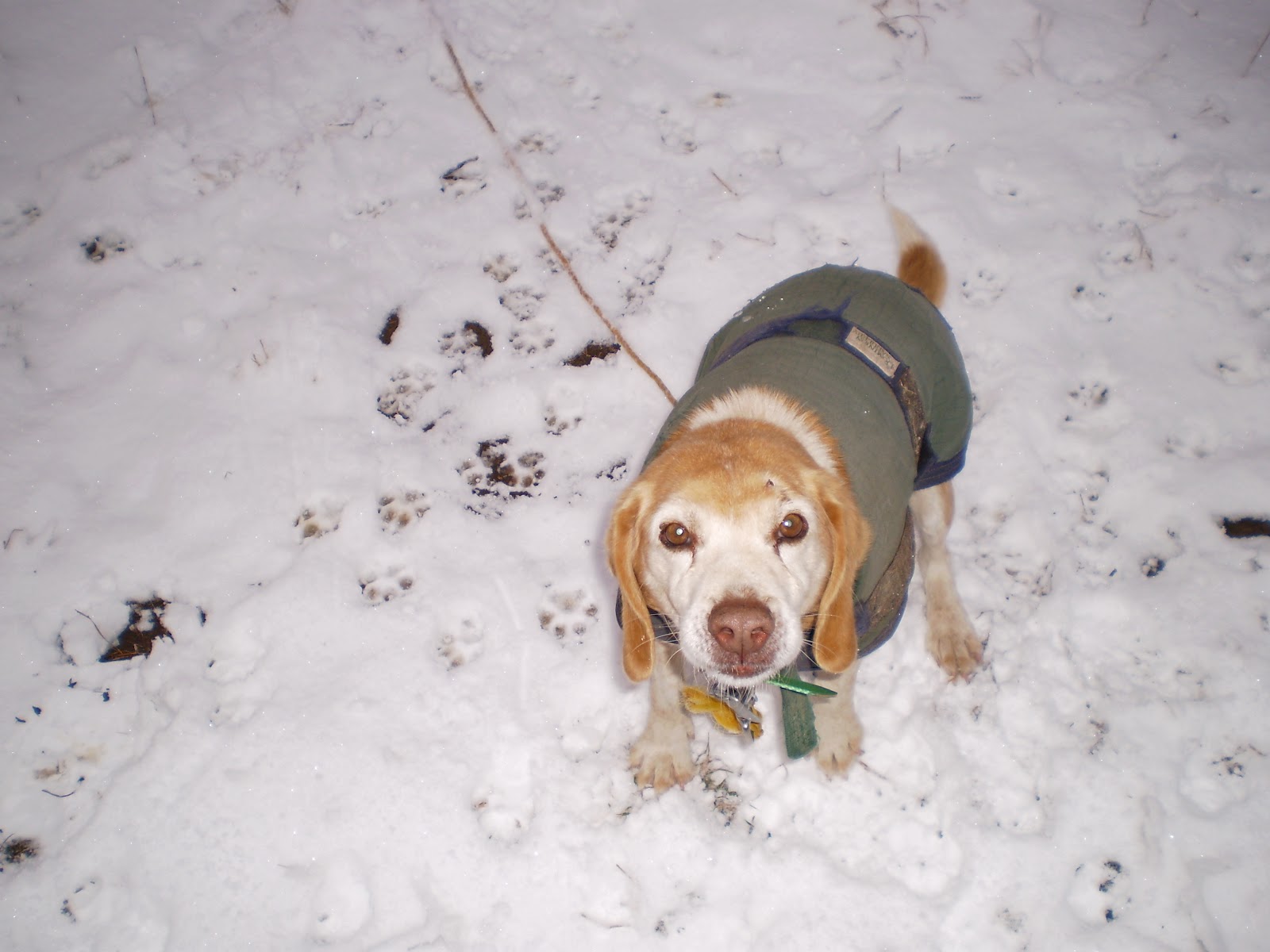
The last three weeks we knew that he was nearing the end of his life. He would look for places to hide in the kennel and outside it. We could comfort him, but he was up all night, and slept during the day. Once, I couldn't wake him easily and wondered if he were dead. Almost deaf now, he was still jumping and happy when he saw us, and he never turned down a small milkbone dog biscuit. As with all the elderly dogs, we put a coat on them at night, to keep them comfortable when the temperature drops.
 |
| Sweet Angus really enjoyed the snow. He also liked to eat some of it. |
This morning my husband called me as soon as he went out to feed dogs. Angus was in the fenced enclosure outside his kennel. He still had his coat on, but it was muddy, and he seemed disoriented. By the time I got down there, he had a grand mal seizure, the first we had ever seen. We promptly put him on a transport board with a chux on it, covered him with a blanket and moved him down to the heated barn room which functions as our animal ICU. The seizure ended and he seemed calm, as most post-ictal creatures are. However, he could not move normally. We believe him to have had a massive stroke over night. Unlike human beings, dogs can recover from strokes. I have had several who have and who lived several years afterward. However, if Angus is as old as the vet suspects, then the kindest thing probably would be to allow him to pass. Initially is heart rate and breathing were regular, and I sat with him as he lay in a nice warm bed with a soft blanket over him. Then, as the morning went by, the respirations changed. Although they were regular, they were occurring less often. The distance between each respiration lengthened and I knew that today would be the day he would leave us. Even though he likely could not hear us, we played soft Christmas music in the barn. I told him how much we had enjoyed having him at the farm and that we would see him again. We told him that he owed us nothing, and could pass on to Jesus, and to Daniel and that he would again see the other dogs that he knew as part of our farm. Angus passed with one more deep expiration at 11:51 am. He is the only one of our dogs whose picture appears in my book Rational Preparedness (p.65 for those of you who have it.) He will be missed by both the animals on the farm, and also by the human beings.
This is the link to the earlier post on canine dementia from my other blog Rational Preparedness: The Blog which concerns Angus:
http://rationalpreparedness.blogspot.com/2012/05/is-it-canine-dementia.html
Interestingly, this is the second pet I have had who passed during the playing of this song. Susan, our 14 year old golden retriever/cocker spanel passed during this song as it softly played in 2006.